Troubleshooting Guide
The Troubleshooting Guide tries to provide solution orientied fixes to reported issues. If your issue is not on this please raise an issue or if you already have a solution please contribute it as a pull request.
SAS Intelligent Decisioning
This part of the troubleshooting guide describes issues that can occur when working with this in SAS Intelligent Decisioning.
Duplicate declaration for VARIABLE
This error can be encountered during testing within SAS Intelligent Decisioning. Here is how the issue might show up for a variable called llmurl:
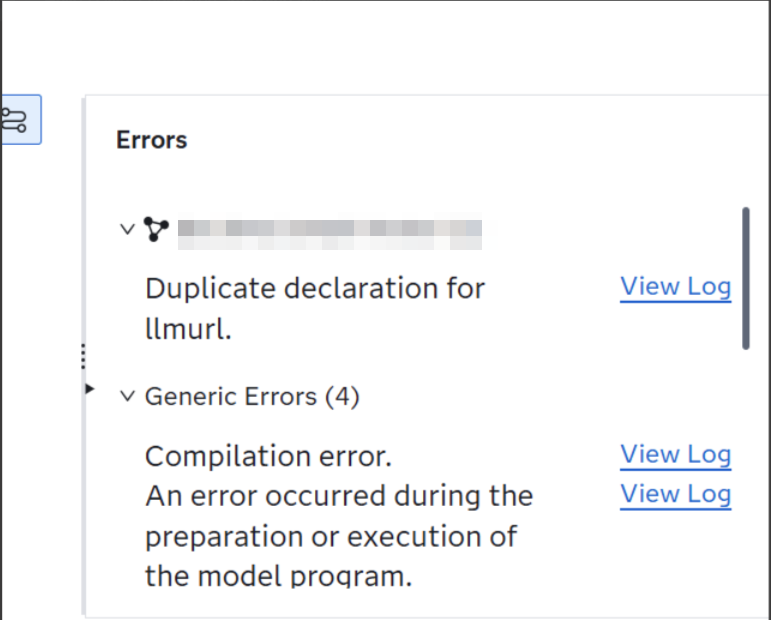
ERROR: Compilation error.
ERROR: Line 167: Duplicate declaration for llmurl.
This error occurs when your model (for example the prompt template model) has the same variable twice in its Variable tab inside of SAS Model Manager. If that is the case, you have identified the source of the error. In order to fix this, please ensure that you are using the current version of the Prompt Builder UI (compare the versions using the project CHANGELOG). If you created the model not using that tool, please make sure that model variables are correctly updated when creating new versions of the model.
DS2 "pymas" package encountered a failure in the 'execute' method
This error can be encountered when testing or running a decision that contains a prompt template that was manifested with the Include the LLM call in the manifested model option:
ERROR: Line 53: DS2 "pymas" package encountered a failure in the 'execute' method.
It means that the Python score code of the model raised an unhandled error. The most common cause is the LLM call itself failing — for example because the certificate of the endpoint hosting the LLM containers is not trusted or the endpoint is not reachable from where the model runs. Here is how to address it:
- Ensure that you are using the current version of the Prompt Builder UI (compare the versions using the project CHANGELOG) and manifest the prompt again. Since version 1.0.0 a failing LLM call no longer raises an error: the failure reason is returned through the response output of the model (e.g. LLM call failed: ...) and parse_status returns 0. Keep the response output selected while validating a decision, so you can see why a call failed.
- If the response output reports a TLS/certificate problem: the model verifies the connection against the CA bundle that SAS Viya mounts into its pods (/security/trustedcerts.pem), which covers LLM containers hosted behind the SAS Viya ingress. If your LLM containers are hosted elsewhere, point the LLMCONTAINERCABUNDLE environment variable to a CA bundle that covers them — see Deployment of Decisions for all supported environment variables and how to set them per runtime.
- If the model fails at publish time instead (py.publish() failed), the requests package is most likely missing from the Python environment. The manifested model ships a requirements.json, so SAS Container Runtime destinations install the package automatically during publishing; for runs in SAS Intelligent Decisioning tests, CAS or MAS, an administrator has to make the requests package available in the configured Python environment.
Please note that the Call LLM node path (prompt templates manifested without the included LLM call) is not affected by this — for that path see the Micro Analytic Service and SAS Container Runtime sections below.
Micro Analytic Service
This part of the troubleshooting guide describes issues that can occur when publishing decisions or models that call the LLMs to the SAS Micro Analytic Service (MAS).
500 Internal Server Error - EXECUTEMETHOD failed for HTTP POST method with URL
This error occurs because the endpoint under which the LLMs are hosted doesn't have a valid certificate from the standpoint of your SAS Micro Analytic Service. This fix has to be done by an administrator with the ability to patch the SAS Viya deployment - for more information check out the SAS documentation:
- Go to $BASE_PATH/sasinstall/sas-bases/examples/sas-microanalytic-score/config and copy the mas-add-environment-variables.yaml
- Then adjust the yaml in the following way - this assumes that you have deployed the LLMs behind the same ingress as SAS Viya if not you need to point it to your certificate accordingly:
---
apiVersion: builtin
kind: PatchTransformer
metadata:
  name: mas-add-environment-variables
patch: |-
  - op: add
    path: /spec/template/spec/containers/0/env/-
    value:
      name: SSLCALISTLOC
      value: /security/trustedcerts.pem
target:
  group: apps
  kind: Deployment
  name: sas-microanalytic-score
- Add the transformer to your kustomization.yaml and apply it.
- Check the environment variables of the sas-microanalytic-score pod definition and there under the sas-microanalytic-score container check that the environment variable was added accordingly.
- Now rerun your the decision/model call and check that the error has been actually fixed.
SAS Container Runtime
This part of the troubleshooting guide describes issues that can occur when publishing decisions or models that call the LLMs to a SAS Container Runtime (SCR) publishing destination (independent of AWS, Azure, GCP or Private Docker).
SSL Error: Missing CA trust list
This error is mostly likely caused by the fact that you are using a certificate for the LLM containers that isn't valid according other SCR containers - this might be because you are using a self-signed certificate or organization signed. This fix has to be done by the person that deploys the container - for more information check out the SAS documentation:
---
apiVersion: apps/v1
kind: Deployment
metadata:
  name: <CONTAINER>
  namespace: <NS>
spec:
  selector:
    matchLabels:
      app: <APP_NAME>
  template:
    metadata:
      labels:
        app: <APP_NAME>
    spec:
      containers:
      - name: <APP_NAME>
        image: <CONTAINER_REGISTRY>/<CONTAINER>:latest
        resources:
          requests:
            memory: "4000Mi"
            cpu: "1000m"
        ports:
        - containerPort: 8080
          protocol: TCP
        env:
        - name: SAS_SCR_SSL_CERTIFICATE
          value: /ssl/certificate-file.crt
 ... Shortend for brevity
Please note that you have to mount the certificate file in a volume to the container!