Setup SAS Model Manager
The SAS Agentic AI Accelerator will create an additional model repository in your environment called LLM Repository. This repository will be used both to store the project which contains the LLMs, all the different prompting projects, the embedding models and the RAG setups.
The repository and its projects are created by mdb setup, part of the Model Definition Builder. It creates the LLM Repository, the LLM Model Project and the Embedding Model Project if they do not already exist, and it is idempotent — running it again on an environment that is already set up changes nothing. (You do not have to run it explicitly at all: mdb register performs the same check automatically for the kind it registers. Running mdb setup up front is simply the tidiest way to bootstrap a fresh environment.)
Install the CLI once, then run setup from within the locally cloned repository. The connection details are read from a .env file — see Providing credentials without the command line:
# Install the CLI with the Viya extra (one time)
pip install -e "Model-Definition-Builder/cli[viya]"

# Create the repository and both model projects, and write the seed files
mdb setup
mdb setup reads the SAS Viya server from SAS_VIYA_URL and signs in with whichever credential you provide (see Signing in to SAS Viya - a password is not required), the point of contact from SAS_RESPONSIBLE_PARTY, the SCR base URL from SAS_SCR_ENDPOINT, and the deployment type from SAS_DEPLOYMENT_TYPE (k8s by default, or aca for Azure Container Apps/Instances). All of these live in your .env.
It also loads the release table Public.ACCELERATOR_RELEASES into CAS (the caslib from SAS_CAS_LIBRARY, the name from SAS_RELEASES_TABLE) - the accelerator's changelog as one row per release and per change. That is the table you assign to the Prompt Builder and RAG Builder objects in SAS Visual Analytics, see Deploying the Builder UIs; reload it after an upgrade with mdb load-releases, or skip it here with --no-releases.
Running it produces two additional json files as outputs, that are required for the steps on the page Deploying the Builder UIs:
- llm-prompt-builder.json, this will enable your users to do No-Code Prompt Engineering.
- rag-builder.json, this will enable your users to do No-Code RAG pipeline setups.
Use --out <dir> to write those files somewhere other than the current directory, or --no-files to create only the repository and projects. Run mdb setup --help for the full list.
Providing credentials without the command line
mdb reads any parameter from an environment variable or a .env file instead of the command line. This keeps your credentials out of your shell history and the process list. The order of precedence is: command-line argument, then environment variable, then .env file, then the built-in default.
To use a .env file, copy the template and edit it (mdb reads it itself, nothing else to install):
cp .env.example .env
The available variables (documented in .env.example) map to the arguments as follows:
| Environment variable | Purpose |
|---|---|
SAS_VIYA_URL | SAS Viya server URL (falls back to the SAS Viya CLI profile's sas-endpoint) |
SAS_VIYA_TOKEN | An OAuth access token - the first credential tried |
SAS_VIYA_USER / SAS_VIYA_PASSWORD | Username and password for the password grant - tried second |
SAS_VIYA_VERIFY_SSL | Set to false only for an unrecognized self-signed certificate |
SAS_SCR_ENDPOINT | Base SCR endpoint URL |
SAS_DEPLOYMENT_TYPE | k8s (default) or aca |
SAS_RESPONSIBLE_PARTY | Point of contact recorded in Model Manager |
SAS_PUBLISH_DESTINATION | Default SCR publishing destination (mdb publish, overridable with -d) |
SAS_CAS_LIBRARY / SAS_CAS_SERVER | CAS library (default Public) and server for the tables mdb setup, load-releases and load-facts load |
SAS_RELEASES_TABLE | Name of the release table (default ACCELERATOR_RELEASES) |
The .env file is git-ignored, so your credentials are never committed. With the connection details in .env (or a SAS Viya CLI login, below), mdb setup needs no arguments at all.
Signing in to SAS Viya
Every mdb command that talks to SAS Viya signs in the same way, trying three credentials in this order and using the first one that is set. Each command prints which one it used (SAS Viya: <server> with ...).
-
SAS_VIYA_TOKEN- an OAuth access token from any source.mdbreads its expiry from the token and tells you when it has run out instead of failing on the first request. -
SAS_VIYA_USER+SAS_VIYA_PASSWORD- the password grant. This is the classic route and still the simplest for a service account, but it does not work when SAS Viya authenticates through an external identity provider (SSO / SCIM / OIDC), where the only account with a password is typicallysasboot. -
The SAS Viya CLI login. If neither of the above is set,
mdbuses the access token the SAS Viya CLI keeps in~/.sas/credentials.json:sas-viya profile init # once: the server URLsas-viya auth loginCode # opens the browser and completes the SSO loginmdb setup # -> SAS Viya: https://... with the SAS Viya CLI login (profile Default, expires ...)sas-viya auth login(username and password at the prompt) fills the same file. The profile isDefaultunlessSAS_CLI_PROFILE- the CLI's own variable - names another, and a login for a different server thanSAS_VIYA_URLis refused rather than silently used. When the login expires,mdbsays so; runsas-viya auth loginCodeagain.
On an SSO site, route 3 is all you need: leave SAS_VIYA_USER and SAS_VIYA_PASSWORD out of .env, log in with the CLI, and the repository, projects and registered models are created in your name rather than a service account's. Route 1 exists for the cases where the token comes from somewhere else - a CI secret, the VS Code SAS extension, or an authorization-code flow you completed yourself.
Authorizing the Repository
By default newly created SAS Model Manager repositories are only authorized for access for the SAS Administrators group, please adjust the access rights as you require it for your environment - it is recommended add authorization on a group basis.
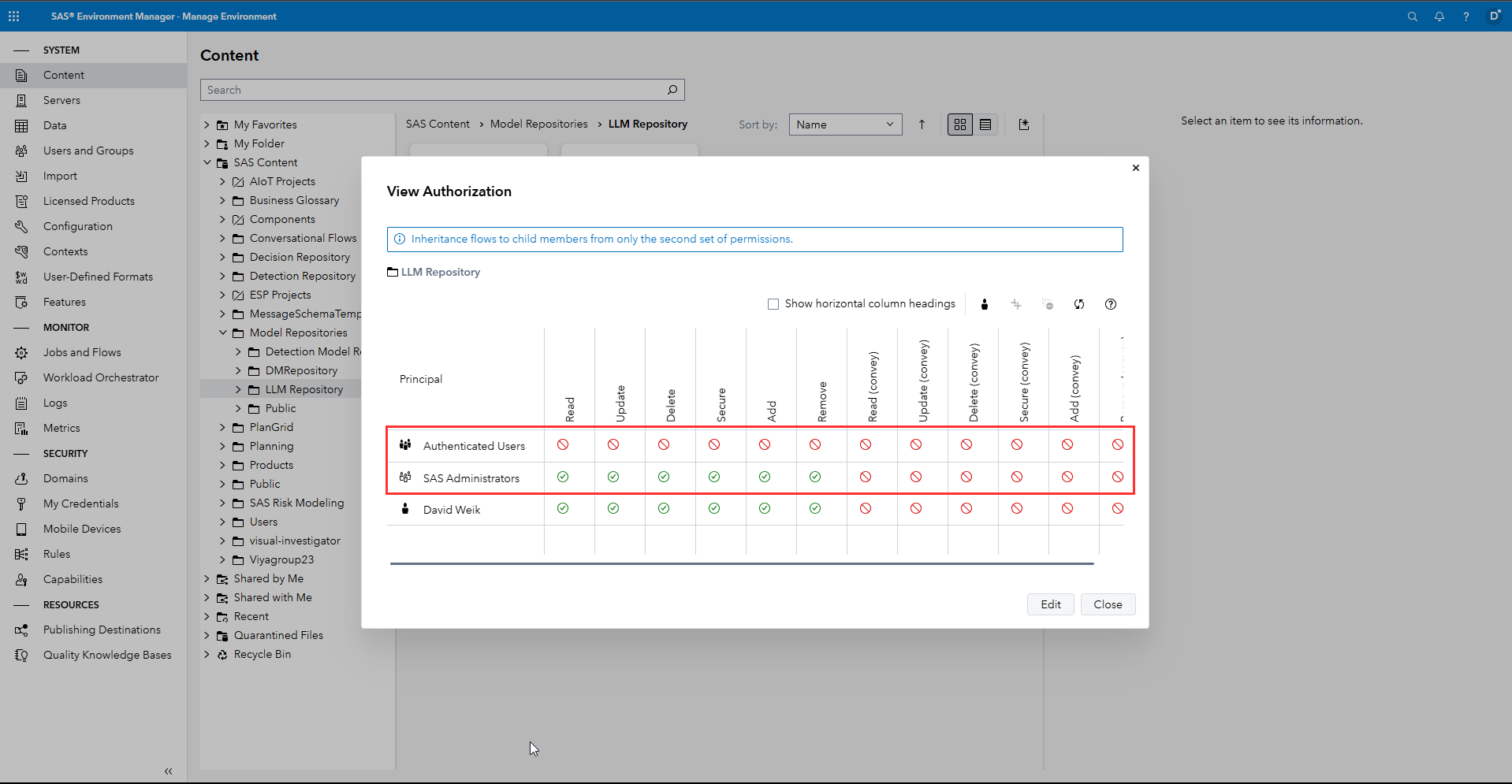
Running mdb setup will produce a file called sas-viya-cli-commands.txt which contains the following groups and rules as a template to apply authorization to your environment. Of course this is just a basic template, please read through it carefully and adjust it to your needs:
# Each command comes with a description, please read it and the documentation before running anything

# First a Custom Group is created called LLM Consumers - if you do not want use this group, skip this step and replace the name in subsequent commands
sas-viya identities create-group --id LLMConsumers --name "LLM Consumers" --description "This group enables a general access to the LLM repository. This group is meant for anybody that requires access to it."
# Add members to the LLM Consumers group
sas-viya identities add-member --group-id LLMConsumers --group-member-id GroupYouWantToAdd

# Second a Custom Group is created called Prompt Engineers - if you do not want use this group, skip this step and replace the name in subsequent commands
sas-viya identities create-group --id PromptEngineers --name "Prompt Engineers" --description "This group enables its members to create, update and delete Prompt Engineering projects in the LLM repository"
# Add members to the Prompt Engineers group
sas-viya identities add-member --group-id PromptEngineers --group-member-id GroupYouWantToAdd

# Create two rules that open up access to the LLM Repository for the LLM Consumers
sas-viya authorization create-rule -o /folders/folders/folder-uuid -g LLMConsumers -p Read,Add,Remove -d "Enables the LLM Consumers to interact with the LLM repository" --reason "You are not part of the LLM Consumers group"
sas-viya authorization create-rule --container-uri /folders/folders/folder-uuid -g LLMConsumers -p Read,Add,Update,Remove,Delete -d "Enables the LLM Consumers to interact with the LLM repository" --reason "You are not part of the LLM Consumers group"

# Create a rule to enable the Prompt Engineers to create new projects in the LLM repository
sas-viya authorization create-rule -o /modelRepository/repositories/repo-uuid -g PromptEngineers -p Read,Add,Create,Update,Remove,Delete -d "Enables the group to create prompt engineering projects in the LLM repository" --reason "You are not part of the prompt engineering group"